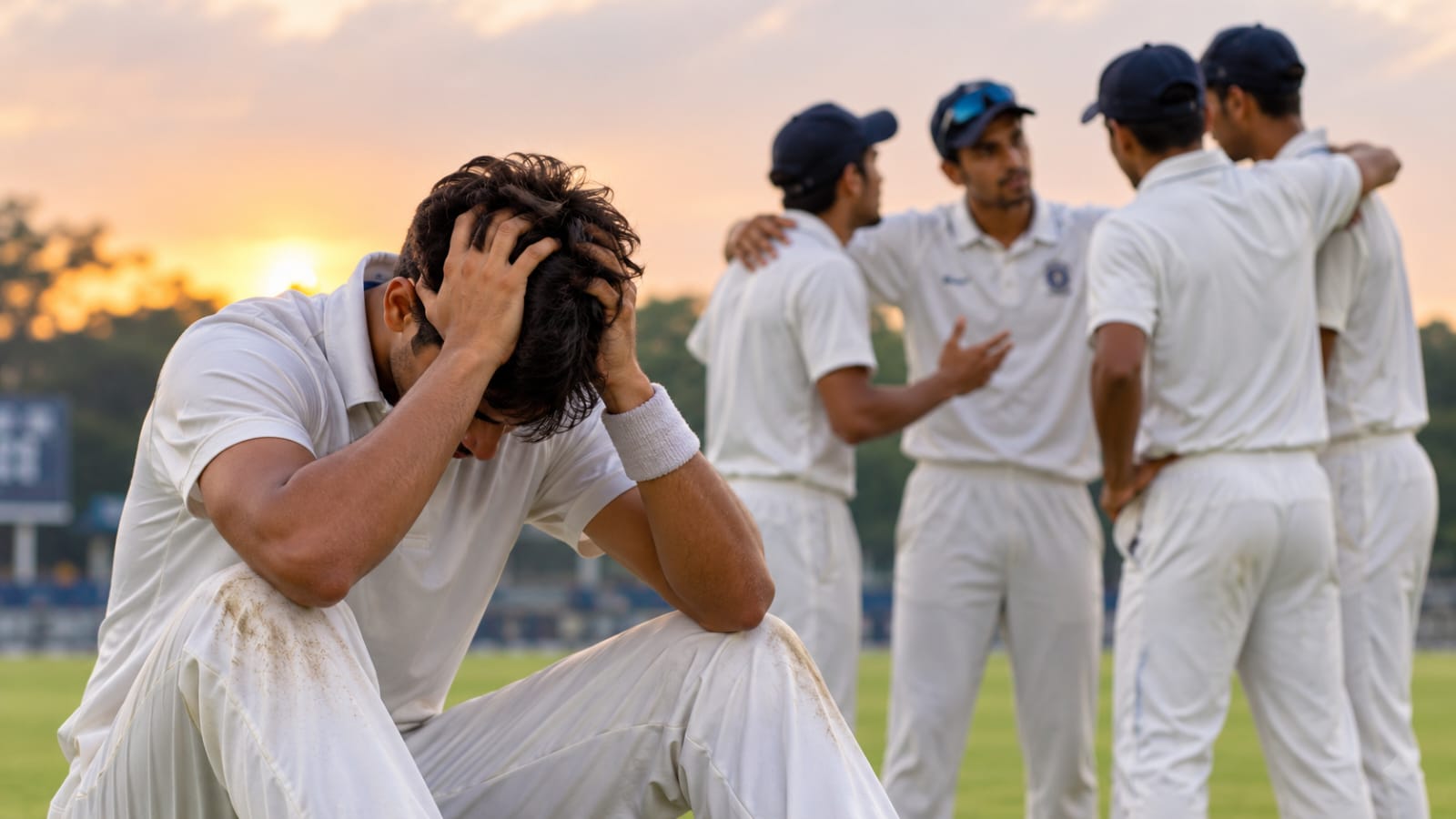
Why One Teammate's Mistake Can Affect Everyone
In team sport, performance is rarely an individual experience.
A teammate drops a catch, misses a pass, loses a point, makes the wrong run or fails to follow an agreed plan—and suddenly your own emotions can change. You may feel frustrated, lose confidence in the teammate, start communicating less, or become overly focused on preventing the next mistake.
The problem is not simply the mistake itself. It is what happens psychologically after the mistake.
Research in sport psychology consistently highlights the importance of team cohesion, communication and collective efficacy for effective team functioning and performance.
The Psychological Chain: Mistake → Emotion → Reaction → Performance
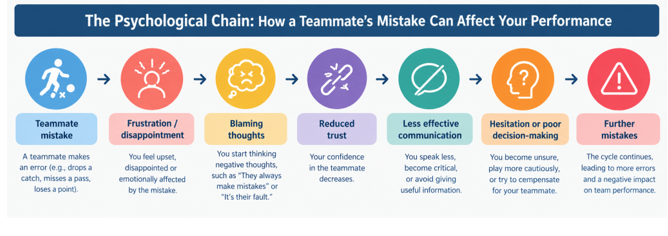
The objective is not to pretend that mistakes do not matter. Instead, athletes need to learn how to respond to mistakes without allowing one moment to control the next one.
What Happens to Confidence and Decision-Making?
1. Attention can shift away from the task. After a teammate makes an error, an athlete may spend valuable attention thinking: “Why did they do that?” or “I have to cover for them.” This takes attention away from immediate performance demands.
2. Confidence in the team can decrease. Repeated mistakes may cause an athlete to question whether the team can execute its plan successfully. This is relevant to collective efficacy—the team's shared belief that it can organise and execute the actions required to succeed.
3. Communication can become reactive. Instead of giving useful information such as “I've got cover” or “Next ball, stay positive,” communication may become critical.
4. Decision-making can become overly cautious. An athlete who no longer trusts a teammate may try to compensate for them, leading to forced plays or abandoning the original tactical plan.
Sporting Example 1: Cricket
Cricket provides many situations where teammates depend on one another while also performing individually.
Consider a fielder who drops an important catch. A teammate's immediate emotional response may be disappointment. That is normal. The psychological challenge is what happens next.
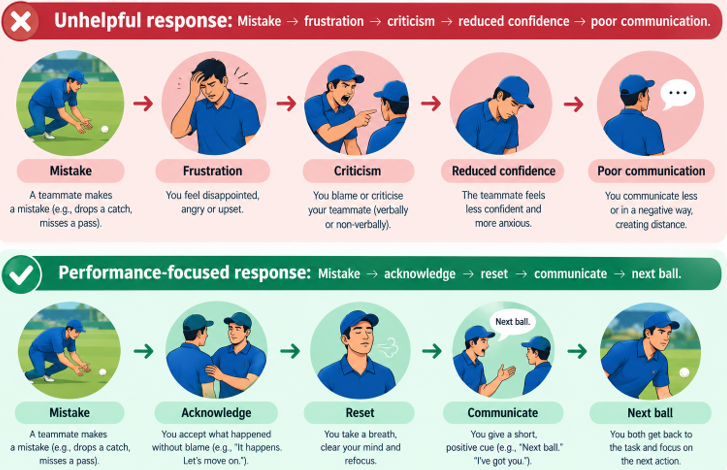
A teammate might simply say: “Forget it. Next ball. We are still in it.” This does not mean ignoring accountability. The technical issue can be reviewed later. During competition, however, the immediate priority is often to restore attention to the next controllable action.
Sporting Example 2: Football
Football requires continuous coordination between teammates.
Suppose a midfielder loses possession and the opposition creates a dangerous counterattack. A defender who becomes frustrated may begin thinking, “I cannot trust this player.” The defender may then position themselves differently, communicate less, or attempt to cover spaces outside their role.
Now the original individual error has affected the team's tactical coordination.
A more effective response is: “Reset. Stay compact. Next action.” The team does not need to decide who is responsible while the game is still moving. It needs to organise itself for the next phase.
Sporting Example 3: Badminton Doubles
The same principle applies in a more direct partner sport such as badminton doubles.
When one player misses an easy shot, their partner may immediately show frustration through facial expressions, body language or negative comments. The player who made the mistake may then become more anxious about making another error.
Instead of playing naturally, both athletes may become focused on avoiding mistakes.
In doubles, communication and coordination are particularly important because partners must continually adjust their positioning and movements in response to one another.
The lesson is simple: Your partner's mistake does not automatically have to become your emotional mistake.
Five Practical Strategies Athletes Can Use
1. Use the “Next Action” Reset
After a teammate makes a mistake, consciously shift attention from what happened to what needs to happen next. Ask: What is happening now? What is my role? What is the next controllable action? Use a short cue such as “Next ball,” “Next play,” or “Reset.”
2. Separate the Person From the Mistake
A mistake is an event—not an identity. Compare “You are always careless” with “We lost that ball. Let's reset and communicate earlier.” The second response addresses the behaviour without attacking the person.
3. Replace Blame With Useful Communication
Good team communication should provide information that helps the next action. Instead of “Why weren't you there?” try “Next time, I'll call earlier.” A useful communication rule is: See it → Say it → Support it.
4. Clarify Roles Before Competition
Before competition, teammates should clarify who takes responsibility in specific situations, what communication cues they will use, what happens when the original plan breaks down, how they will respond after an error, and what each athlete needs from the others.
5. Build Trust Through Small Repeated Behaviours
Trust develops through repeated experiences of keeping commitments, communicating clearly, supporting teammates after mistakes, accepting feedback, fulfilling one's role, and staying composed under pressure.
Two More Strategies That Can Make a Difference
6. Use a “Pause–Breathe–Choose” Routine
Pause: Notice the emotional reaction. Breathe: Take one slow breath and release unnecessary tension. Choose: Decide what response will help the team now. Emotional regulation does not mean eliminating frustration; it means developing the ability to respond to frustration in a way that supports performance.
7. Review the Problem—Don't Re-Live It
After training or competition, teams can discuss mistakes constructively using three questions: What happened? What can we learn? What will we do next time? This turns conflict into learning.
Practical Team Exercise: “Reset–Reconnect–Refocus”
Teams can practise this routine during training and before competition.
Step 1: Reset — 5 seconds. After a mistake, each athlete takes one breath and physically resets their posture. Cue: “Reset.”
Step 2: Reconnect — 5 seconds. The nearest teammate gives one short supportive communication cue, such as “I've got you,” “Next one,” “Stay with me,” or “We reset.”
Step 3: Refocus — 5 seconds. Each athlete identifies their next role or action. Ask: “What do I need to do now?”
Step 4: Continue. No discussion of blame during the immediate performance moment.
Step 5: Review later. At the end of the training session, spend 2–3 minutes discussing what communication worked, where frustration appeared, whether the team recovered quickly, and what cue should be used next time.
The Goal Is Not to Avoid Conflict
Healthy teams are not teams where nobody disagrees. Athletes can have different opinions about tactics, roles and decisions. The important question is how the disagreement is handled.
A team that can say, “That didn't work. Let's find a better solution,” is psychologically different from a team that says, “That didn't work because of you.” The first approach keeps attention on the task. The second can shift attention towards blame and relationships.
The relationship between conflict and performance is more complicated than simply saying that all conflict is bad or all disagreement is useful. How athletes regulate emotions and manage interpersonal relationships matters.
Building a Stronger Team Starts With the Next Response
Mistakes are inevitable in sport. A dropped catch, missed pass, poor shot or tactical error does not have to determine what happens next.
The strongest response is often not a dramatic motivational speech. It may be something much simpler: Take a breath. Communicate clearly. Trust the role. Focus on the next action.
Over time, these small behaviours can contribute to stronger cohesion, communication and collective confidence.
For athletes, mental performance is not only about controlling individual thoughts before competition. It is also about learning how to remain focused, emotionally controlled and constructive when things do not go according to plan.
How CML Can Help
At CML, mental-performance training can help athletes develop the psychological skills required to perform effectively both individually and as part of a team.
Through structured mental-performance work, athletes can practise focus, confidence, emotional regulation, performance routines, constructive self-talk and recovery after mistakes. These skills can support better communication and coordination when competitive pressure increases.
Ultimately, the goal is not simply to make athletes better at handling mistakes. It is to help them become athletes who can reset quickly, trust their teammates, communicate effectively and stay connected to the performance task—even when the game becomes difficult.
Because in team sport, performance is not only about what you do when everything goes right. It is also about how the team responds when something goes wrong.
Want to apply this with a coach?
Turn this insight into a practical mental performance routine for your sport.
Explore Programs